
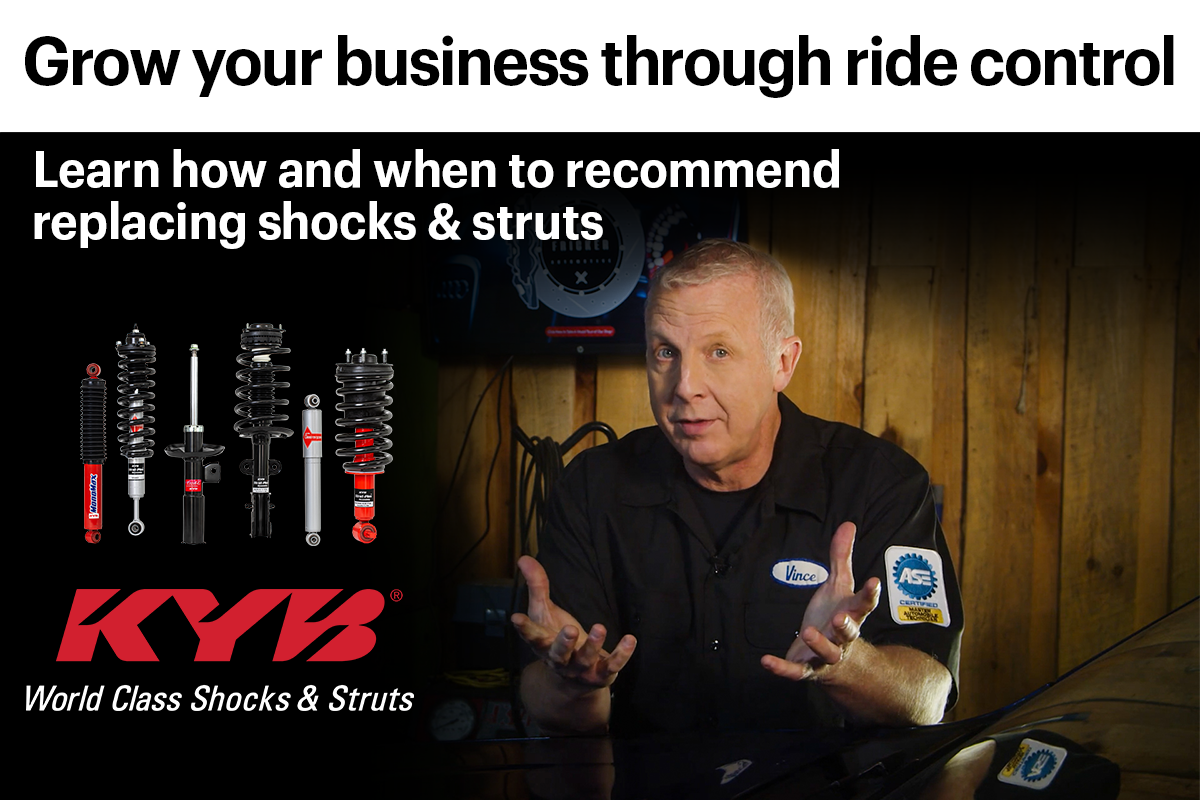
Grow your business through ride control maintenance.
(SPONSORED CONTENT)
Most technicians know that replacing shocks and struts is worth doing at some point in a vehicle’s lifetime. But many technicians won’t know when to suggest new dampers, and likely never check a shock’s performance beyond a simple visual inspection. Maybe that’s why so many vehicles in the junkyard still have their original suspension components installed.
Knowing the reasons why, and more importantly when, to replace shocks, struts, and other suspension components can help you start a ride control replacement conversation with customers. Two of the most common replacement reasons are maintenance and repair. Instead of only replacing worn, leaking or broken shocks, try asking customers if their vehicle is performing the way it did when it was new. Shocks wear slowly over time, and most people don’t focus on how they’ve adapted their driving style to compensate for worn suspension. They won’t realize they’ve been subconsciously driving over bumps differently to avoid harshness or rattling components, changing their braking points to account for more nosedive, or other behaviors that indicate worn suspension components. Getting them thinking and taking an honest approach to their vehicle’s performance can help them drive a safer vehicle on the roads that we all share.
Even on well paved roads, dampers can move up and down 1,500 times in a mile. After 50,000 miles, that can exceed 75 million cycles of the inner workings of a damper. Those inner components wear over time, which leads to a gradual performance decrease. Many shocks are worn before they show signs of failure or leaking, but technicians don’t always know what to look for, or how to begin the conversation to suggest a replacement. KYB offers free virtual training for professionals on kyb.com/training to help educate technicians and service writers. We’ve also developed a method for road testing a vehicle to determine suspension wear that we call, “The 3 Minute Mile.” Put simply, it involves finding a repeatable route in your vicinity that will allow for a few simple testing maneuvers. These specific maneuvers reveal how a vehicle’s suspension is performing in the real world and if further suspension diagnosis or replacement is warranted. Learn how to perform a 3 Minute Mile road test here: https://www.kyb.com/resources/technical-information/3-minute-mile/
KYB OE replacement shocks and struts are engineered to help restore a vehicle’s original designed ride control and compensate for other worn suspension components. Excel-G and Strut-Plus are well known for being the right OE replacement choice for many of your customers. Pairing quality shocks and struts with new brakes, and/or new tires, can really help bring a vehicle back to life. It’s a great strategy to make a vehicle much safer. Having the confidence to start a ride control conversation with your customers can help them protect their investment.
How else can I increase shock and strut sales?
Maintenance and repair are two obvious reasons to replace shocks and struts, but there is an entire world of suspension upgrades to explore. KYB has you covered there too, and can help you capitalize on those opportunities. KYB manufactures parts that are designed as performance upgrades over OE suspension components. More vehicle capability through suspension upgrades is an option your customers may have overlooked.
Start by asking customers how they use their vehicle. Many vehicles are used as basic commuters, but plenty of vehicles are used for work, adventuring, or other activities that warrant more suspension performance. There are huge opportunities for installing upgraded suspension parts on large vehicles such as trucks and SUVs. Look for trailer hitches, roof racks, larger tires, and other indicators to see if they could benefit from the added control of shock and strut upgrades. In many cases, the best upgrade option is a monotube damper with its higher pressures and additional damping force. It’s a more capable option for vehicles like trucks that have a higher center of gravity and need more stability. KYB offers Gas-a-Just and MonoMax monotube products as performance upgrades and can provide an easy way to improve your customer’s vehicle.
For those that regularly use their truck for hard work like towing, hauling, or plowing, KYB monotubes can be the right choice. Several trucks are factory equipped with monotubes, and the KYB Gas-a-Just can be either an OE monotube replacement, or a performance upgrade, depending on the application. It’s a great choice for vehicles that demand performance. The other monotube option is the KYB MonoMax, which is a maximum control monotube. It’s always an upgrade over OE, and it offers even higher performance for those hard working trucks. KYB parts can be mixed and matched between front and rear axles to find the right balance of capability.
Additionally, there are complete strut assemblies made with monotubes in the Truck-Plus product line. Truck-Plus offers options for leveling and added performance that come complete with a new mount and spring for quicker and easier installation. They are engineered, tested, and built to the same standards as our OE replacement Strut-Plus products, so you can be confident in recommending and installing them. Trucks and SUVs are great examples of shock and strut replacement opportunities, and they are increasingly popular in North America.
There are many opportunities to recommend new shocks and struts, and knowing what to look for can lead to sales, and safer, happier customers. Just planting the seed about how your customer’s vehicle is performing can lead to future opportunities for you and help make a customer’s vehicle safer and more capable.
Pro Tip: In winter, it can take a while for suspension components to warm up and perform correctly. If a vehicle feels really stiff when you start driving it on a cold day, see if it still performs that way after the rubber components and hydraulic fluid in the dampers gets moving and reaches optimal temperature ranges. If it doesn’t, it may be time to replace your shocks and struts!
0 Comments