

Canada’s auto sector is feeling the impact of ongoing trade frictions with the United States, with potential implications for what aftermarket shops see in their bays.
For Canada’s auto service and aftermarket professionals, the story is worth watching closely. While tariffs may not yet be influencing showroom sticker prices, they are already reshaping supply chains. That could eventually filter down into the availability and cost of replacement parts, the mix of vehicles arriving at service bays, and long-term customer expectations.
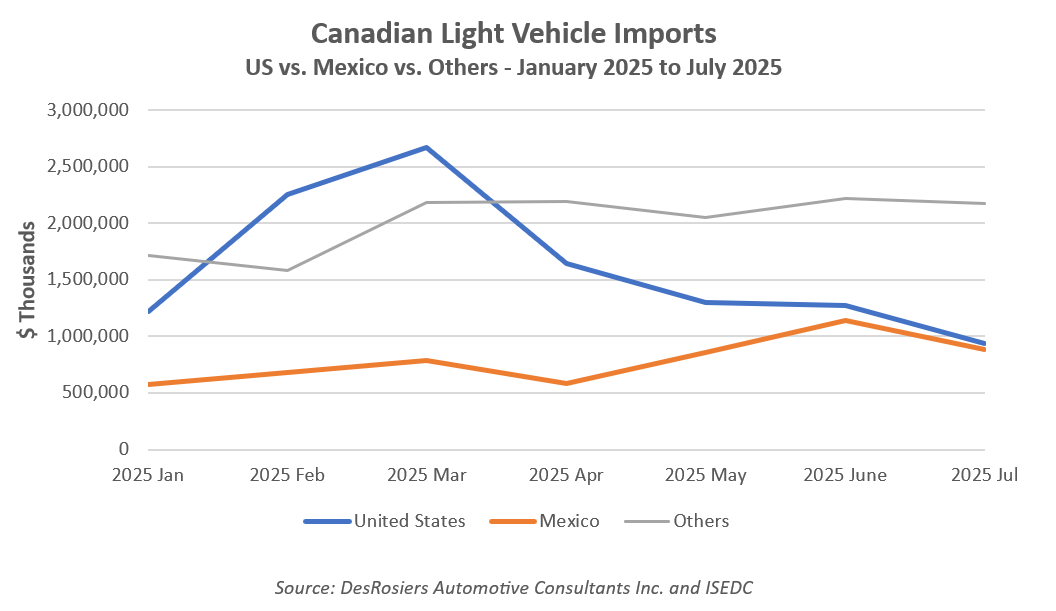
According to DesRosiers Automotive Consultants, import data reveals how dramatically continuing tariffs on U.S. vehicles has reshaped the flow of vehicles into Canada in 2025. Anticipating tariffs, Canadian automakers rushed to bring in U.S. vehicles early in the year, effectively stockpiling inventory. Imports surged in March, more than doubling the value reported just two months earlier.
That strategy provided only a temporary buffer. Once Canada’s counter-tariffs took effect on April 9, imports from the U.S. collapsed and have been in steady decline ever since. Automakers, unwilling to absorb the tariff hit, began shifting sourcing where possible. Imports from Mexico surged as a result, with June values almost 99% higher than in January. Other international markets also saw modest gains, but Mexico has clearly been the standout beneficiary of the policy shift.
By mid-summer, however, the industry’s early cushion of pre-tariff U.S. vehicles was running down. Anecdotal reports suggest much of this stockpile has now been depleted, leaving automakers—and dealers—at a crossroads. Will U.S. imports continue to slide, or will buyers absorb higher landed costs to keep product moving north?
Despite these sourcing shifts, the consumer market has yet to feel significant price pressure. According to CPI data, new vehicle prices in Canada rose just 3.9% year-over-year in August 2025, a modest increase given the volatility in sourcing and logistics.
Still, the stability may not last. “The path ahead in terms of auto tariffs remains unclear,” said Andrew King, Managing Partner at DesRosiers Automotive Consultants. “It seems unlikely that the market can wait much longer for a resolution, and logistics and prices will continue to shift to align with the current reality.”
For now, the message is clear: the trade picture remains unsettled, and the aftermarket will need to stay nimble as sourcing strategies evolve.
What Tariffs Mean for Independent Shops
While the tariff battle may feel like an issue for automakers and importers, it has real downstream implications for independent repair shops.
As vehicle sourcing shifts away from the U.S. and toward markets like Mexico, the mix of vehicles showing up in your bays could change. That means staying alert to differences in platforms, components, and even part numbers tied to regional builds. Supply chains for replacement parts may also see delays or substitutions as distributors adapt to new sourcing realities.
For shop owners, the best defence is preparation: maintain close communication with parts suppliers, monitor lead times carefully, and build flexibility into scheduling when possible. Just as importantly, be proactive with customers. If certain parts take longer to arrive, explaining why upfront will help preserve trust.
Trade uncertainty may be out of your control—but how your shop adapts isn’t.
0 Comments