
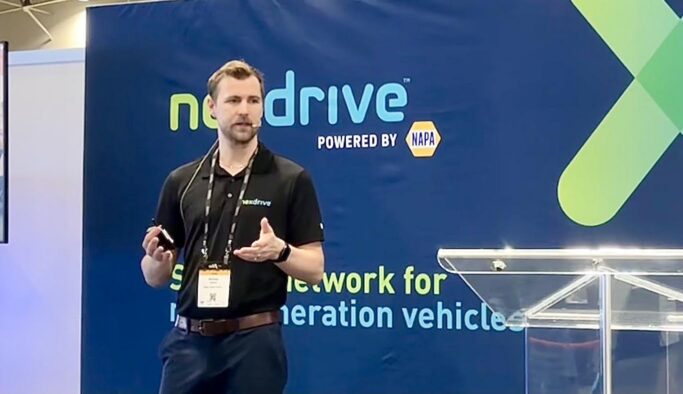
Andrew Ackers, shop owner at Upper James Autopro in Hamilton, Ont., presents on EV service and training at the recent EV + Charging Expo in Toronto.
by Hannah Ryder Ross
Multimedia Content & Analytics Associate
hannah@chatmedia.ca
The shift toward EVs is less a challenge of technology and more an opportunity for evolution within the trade. As vehicles become increasingly software-driven and advanced, technicians have the chance to expand their skillsets beyond traditional mechanical repair into diagnostics, electronics, and systems-based thinking.

Upper James Autopro
Rather than replacing existing expertise, this transition builds on it—strengthening overall capability across the shop. At the Annual EV + Charging Expo, Indie Garage spoke to Andrew Ackers, shop owner at Upper James Autopro in Hamilton, Ont. and expert tech, and Yves Racette, Director of Program Development at UAP Inc.
According to both pros, it’s all about how shops can identify and be prepared for the challenges in EV service readiness, and frame it as an opportunity for future business.
‘Ideally they have to get trained because in the future, you might see a lot of problems coming up,” says Yves. “The technology is going so fast, even within two, three years,” says Racette.
“Getting those fundamentals done, I think, is the most important,” says Ackers. “That gives the shop confidence that we’ll probably take on 90% of EV maintenance and repairs on a daily basis.”

Where gaps in foundational knowledge or hesitation around ongoing training exist, they represent clear opportunities for structured development and upskilling. For example, Racette says, NAPA, one of the leading shop networks, estimates that only about 75 to 100 of 650 NAPA shops across Canada are adequately certified. Shops that embrace continuous learning are positioning themselves to lead, in the next phase of automotive service.
At the same time, investment in EV readiness—whether through training, tooling, or process development—does not need to be viewed as a barrier. In many cases, it can be scaled progressively and aligned with real-world demand. As adoption grows unevenly across regions, early adopters within the aftermarket have the opportunity to establish themselves as go-to service providers before the market fully matures.
Validate and strengthen technician competencies
With the advancing technology, “You might not always know what you don’t know,” says Racette.
- Self-assessment can sometimes differ from measured skill levels, particularly as technology evolves.
- Structured evaluations with self-assessment tools, help identify gaps in foundational knowledge and provides a clear pathway for targeted training, ensuring technicians are fully prepared for modern EV and diagnostic work
Reinforce core electrical and diagnostic fundamentals
- EV service highlights the importance of strong foundational knowledge in electrical systems
- Refreshing core principles—such as Ohm’s Law—enhances accuracy and confidence in diagnostics
- These skills are directly applicable across modern vehicles, including ADAS, network communication, and advanced electronics
- Strengthening fundamentals not only supports EV work but elevates overall shop capability across all vehicle types. “The beauty in EV training is that once you’ve established the fundamentals of a high-voltage battery, you can tackle everything,” says Ackers.
Evolve technician mindset toward continuous learning
- As vehicle technology advances, ongoing education in electronics, software, and diagnostics is becoming a core part of the trade
- Expanding training beyond traditional approaches helps technicians stay relevant and confident with modern systems
- EV service is not limited to senior diagnostic technicians—engaging apprentice and mid-level techs can accelerate capability within the shop
As Ackers notes, techs can feel that “the highest level guy, the highest level diagnostic technician, that’s the only guy who can touch these vehicles. And I like to push back- Sometimes we’ll have the youngest techs going in, they’re the ones that are invested in the new technology and they’re the ones who grab onto the training,”
Clarify the accessibility of EV training and systems
- EV service is often perceived as highly complex, but many core systems are built on consistent, repeatable principles
- Foundational knowledge—such as battery architecture and high-voltage safety—applies across a wide range of makes and models
- This consistency allows technicians to build transferable skills that scale from entry-level EVs to premium platforms
- With the right training approach, shops can integrate EV service more efficiently than initially expected
Keep pace with rapidly evolving vehicle technology
- EV systems and vehicle electronics are advancing faster than traditional platforms, requiring more frequent updates in knowledge and process
- Continuous training ensures technicians remain aligned with current service procedures and manufacturer requirements
- Even routine repairs now involve updated steps—such as proper system isolation (e.g., 12V disconnects)—to ensure safe and accurate work
- Staying current helps prevent avoidable errors, protects vehicle integrity, and reinforces overall shop professionalism
Adapt to software-driven diagnostics and digital systems
- Modern vehicle repair increasingly relies on software platforms, cloud-based systems, and OEM diagnostic portals rather than purely mechanical tools
- Technicians must be comfortable working with laptops, scan tools, and connected diagnostic environments as part of everyday workflows
- This shift reflects broader changes across the industry, where sensors, communication networks, and electronic control systems are now central to nearly all vehicle repairs
Strategic investment in EV training and tooling
- While EV readiness is often perceived as cost-prohibitive, entry-level capability is more accessible than many shops expect
- A focused investment in training and essential tools can establish a strong foundation without significant upfront expense
- Many tools used in EV service—particularly for battery work and diagnostics—are transferable across multiple platforms
- As noted by Yves Racette, EV service doesn’t require an extensive tool inventory to get started, making it a practical and scalable entry point for shops
Communicate with your customers about your shop’s capabilities
“The biggest thing right now is that customers don’t know we can do this. They don’t know we can touch EVs. So it’s our job as a shop to educate them and let them know that we can hold on to them,” says Ackers.
- EV service capability is increasingly becoming a key factor in customer retention and shop competitiveness.
- Clear communication and proactive education around EV service offerings help close this awareness gap and keep customers within the aftermarket network, as opposed to the dealership.
- Positioning EV capability as part of standard service offerings strengthens trust and creates new opportunities for long-term customer relationships. Shops with the capability to support newer vehicle technologies have a better chance at retaining long-standing clients as vehicle complexity increases.
EV fundamentals—like battery systems and communication networks—are also highly transferable across platforms, making training more efficient than expected. At the same time, many customers still believe EV service is dealership-only, creating a major opportunity for independent shops to educate and retain clients.
Ultimately, it’s not a question of if EVs will enter your service mix, but how quickly you adapt. Shops that invest early are not just keeping up—they’re positioning themselves for long-term growth in a rapidly evolving market.
0 Comments