
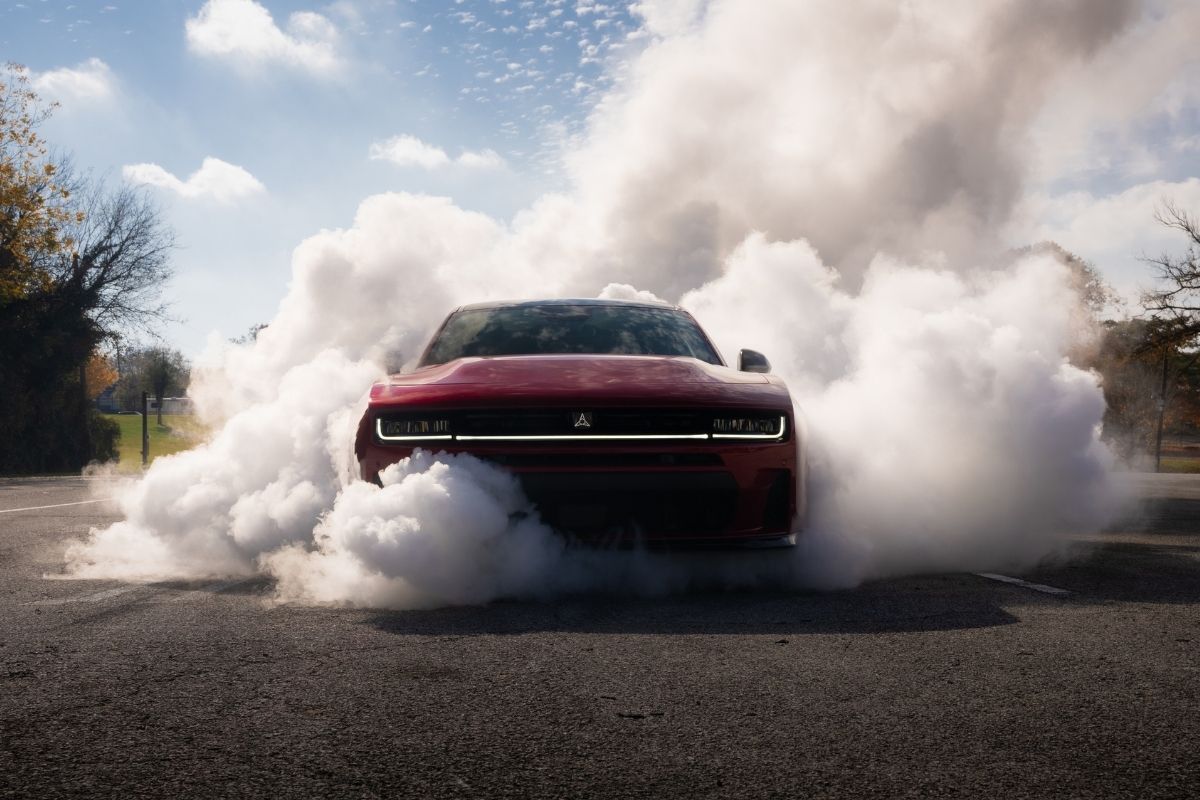
For years I had a stack of old car magazines, one featuring an ad from around 1970 for the original Dodge Six Pack, featuring fire-breathing 440 Six-Pack engine illustration. Or at least that is how I remember it.
That 7.0-liter V8 engine produced a whopping 390 horsepower at the time.
Those magazines are long gone, but nostalgia gets no warmer welcome than in automotive circles so when Stellantis launched its latest performance Dodge Charger for e 2026 model year, it is no surprise that it leaned heavily on the past.
While that original drew its name from the use of three twin-barrel carbs, today’s Dodge Charger SIXPACK is a very different animal.
Built at the Windsor-Ontario assembly plant, the winner of the North American Car of the Year award at the North American International Auto Show just over the river in Detroit—a fact that has workers and Stellantis execs crowing, with justification–that SIXPACK moniker now refers to refer to its new twin-turbocharged straight-six Hurricane engine, with up to 550 hp.
While much has been said about the return to ICE-powered performance of late, the most powerful version of the new Charger is the all-electric 670-horsepower Dodge Charger Daytona Scat Pack (another old name) .
Still, the Hurricane inline-six marks one of the most significant powertrain shifts Dodge has made in decades.
Designed to replace legacy V8 applications in key performance vehicles, the Hurricane is not just about emissions compliance—it is a ground-up rethink of how high output, efficiency, and serviceability intersect in modern ICE platforms.
The Hurricane is a 3.0-litre DOHC inline-six, built around an aluminum block and head, featuring dual independent variable cam timing, direct fuel injection, and two water-cooled turbochargers. In high-output form, it delivers up to 550 horsepower, placing it firmly in traditional V8 territory while offering improved fuel efficiency and reduced emissions.
The foundation of the Hurricane Twin Turbo I-6 engine is a deep-skirt cast-aluminum block with a structural aluminum alloy oil pan. It uses cross-bolted steel main bearing caps to secure the strong rotating assembly, which includes a forged steel crankshaft and forged steel connecting rods. During manufacturing, the block is deck-plate honed to optimize the cylinder bore shape, contributing to improved fuel efficiency.
From a service perspective, turbo management is central to the engine’s design. The Hurricane uses electronically controlled wastegates, integrated charge-air cooling, and advanced thermal management to control intake temperatures under sustained load.
Technicians should expect increased diagnostic emphasis on boost control, oil quality, and cooling system performance, particularly as vehicles age outside warranty.
The inline-six architecture also brings mechanical advantages. Compared with a V-engine layout, the Hurricane offers fewer moving parts, improved balance, and more accessible component packaging—beneficial for both durability and service access. However, tighter emissions controls and complex engine management mean scan-tool proficiency and software awareness are no longer optional.
And for the more nostalgic among us, it should not be forgotten that getting three two-barrel carbs operating smoothly, jetted, and synchronized drove technicians of the day to the edge. You needed special tools for that too.
For the aftermarket, the Hurricane signals Dodge’s commitment to keeping high-performance ICE relevant alongside electrification. Shops that invest early in turbo diagnostics, high-pressure fuel system service, and thermal system expertise will be best positioned as this engine migrates across multiple Dodge and Stellantis platforms.
0 Comments