

The long-running shift away from passenger cars toward SUVs and light trucks shows no sign of slowing in Canada.
The latest new-vehicle sales data reinforces what many service professionals are already seeing roll into their bays: for a growing number of Canadians, the four-door sedan is no longer the default choice.
“Incredibly, the subcompact, compact, and intermediate SUV segments together now account for over 50% of total new light vehicle sales—more than the other 16 segments combined,” said Andrew King, Managing Partner at DesRosiers Automotive Consultants.
“In 2025, mainstream SUVs became even more ubiquitous in dealer showrooms and furthered their absolute dominance of the market.”
For the aftermarket, this trend carries clear and lasting implications. Heavier vehicles, larger wheels, and higher torque outputs—particularly from BEV and PHEV compact and subcompact SUVs—are reshaping parts demand and shop requirements.
Compared to the internal combustion sedans that dominated only a few years ago, today’s SUV-heavy parc is harder on brakes, suspension components, tires, and wheel-end parts.
Shop equipment is also part of the conversation, as larger wheel diameters and higher curb weights place greater demands on tire changers, balancers, and vehicle lifts.
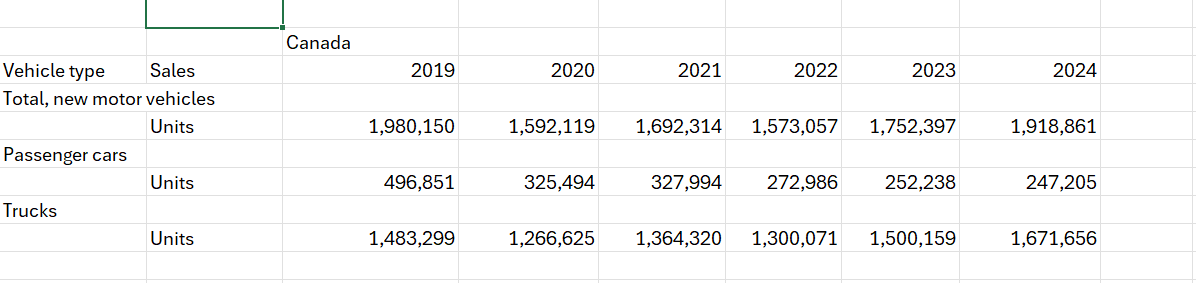
The signs have been there for some time. Looking at the bookend years of 2019 and 2024, total new-vehicle sales in Canada were remarkably similar—1,980,150 units in 2019 versus 1,918,861 in 2024, according to Statistics Canada.
However, passenger car volumes tell a very different story. Passenger car sales fell from 496,851 units in 2019 to just 247,205 in 2024, continuing a steady slide that did not recover after the pandemic.
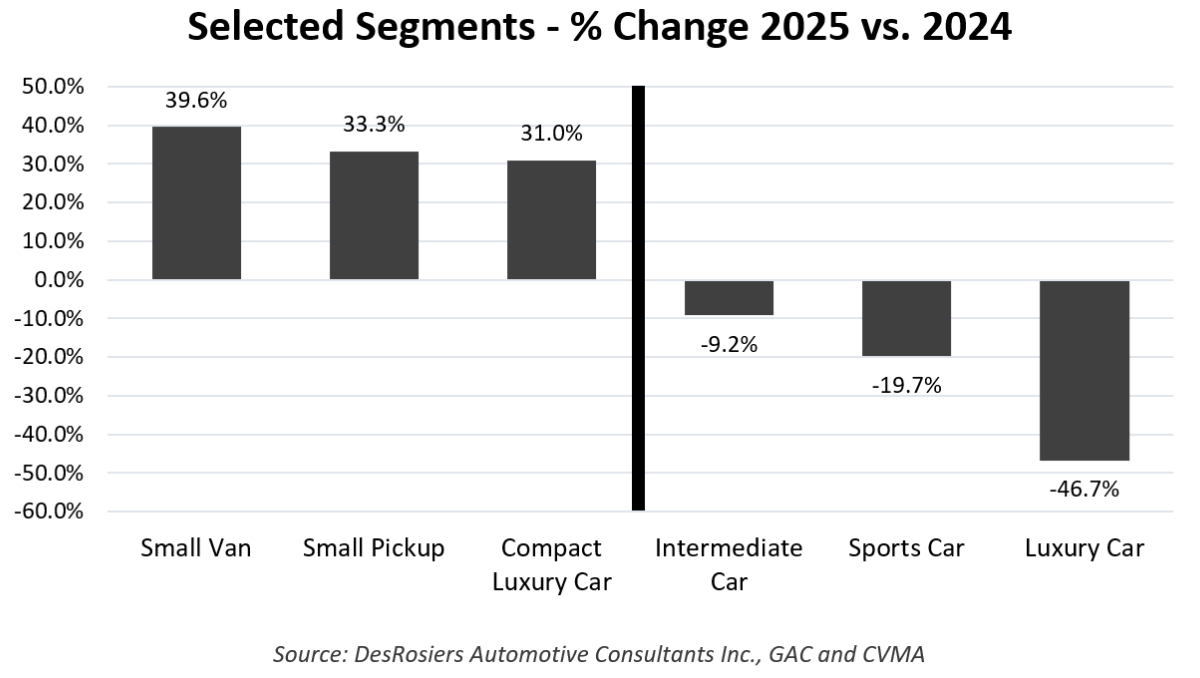
For 2025, DesRosiers Automotive Consultants reports, segment-level performance was unusually dynamic, with a wide spread between top and bottom performers. Compact SUVs led the market, expanding their dominance to more than 553,000 units sold. Large pickups followed at a distant second, with 314,000 units.
Elsewhere, small vans posted the largest year-over-year percentage gain, up 39.6%. While far below their late-1990s peak, 43,000 units sold in 2025 reflects renewed interest in practical, affordable people movers. Small pickups also surged, up 33.3%, led by strong performance from the refreshed Ford Maverick—particularly its hybrid variant—and a resurgent Toyota Tacoma.
At the opposite end of the spectrum, the luxury car segment fell 46.7%, driven in large part by sharply lower Tesla Model 3 sales.
For independent shops, the message is clear: the vehicle mix is changing—and the tools, parts, and training needed to service it must change right along with it.
0 Comments